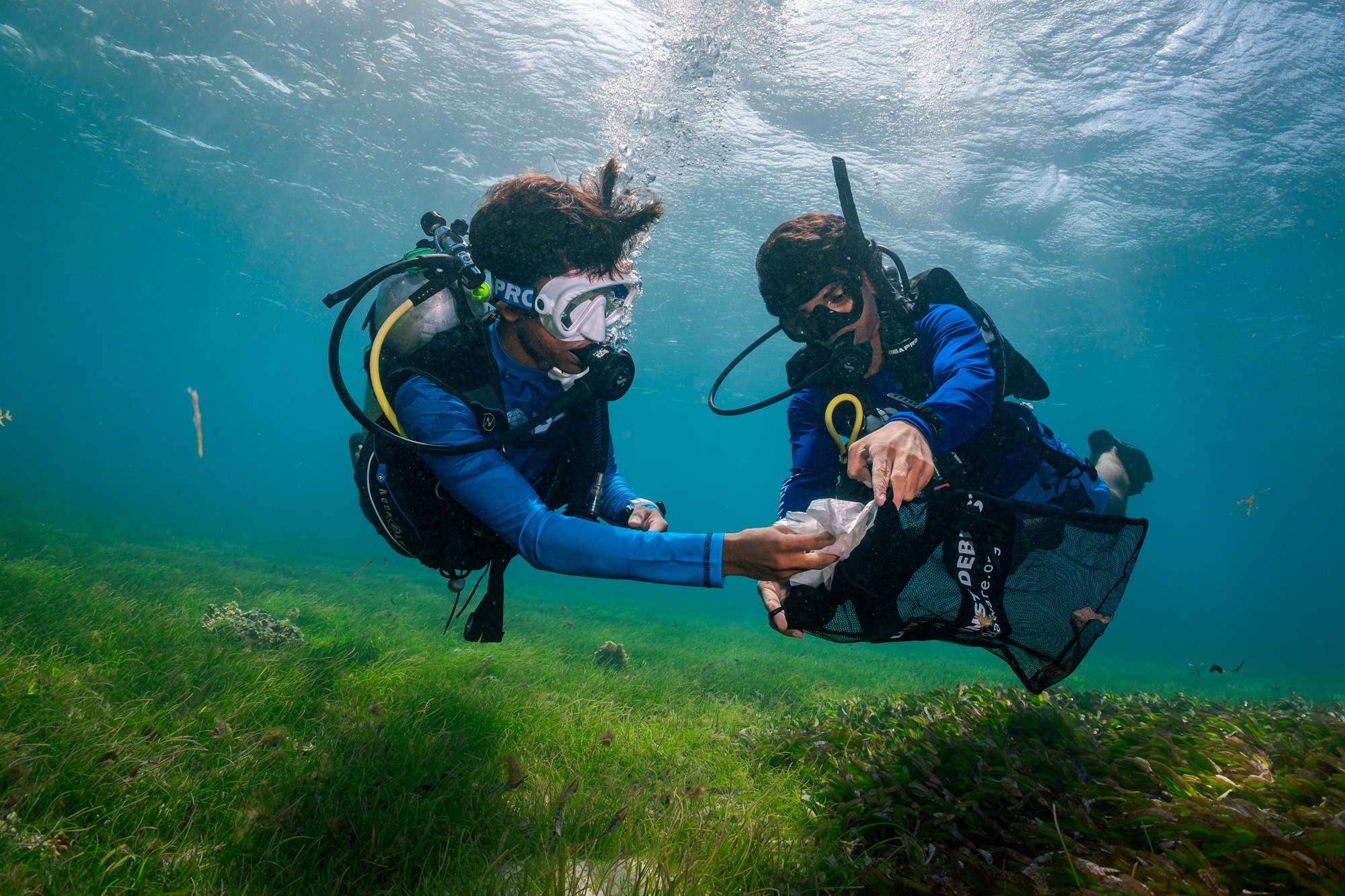
Diving With Purpose: Dominik's Active Commitment to Environmental Protection
The ocean gives dive professionals their livelihood, their identity, and — for many of us — their purpose. It seems self-evident that those who make their careers underwater should be among its most committed defenders. Yet conservation is too often treated in dive education as an elective topic: something to mention in a specialty course, acknowledge in a briefing, or add to a website to signal values.
That’s not how I approach it. In every IDC I teach, environmental stewardship is a thread that runs through the entire programme — not as an addition, but as a foundation. This article explains why, and what that actually looks like in practice.
Why Instructors Carry Disproportionate Responsibility
A PADI Instructor will, over a career, certify hundreds or even thousands of divers. Each of those divers will enter the ocean with the values, habits, and environmental awareness — or lack thereof — that their instructor modelled and transmitted. The multiplication effect is enormous. An instructor who treats buoyancy discipline as purely a skill requirement produces divers who do the same. An instructor who connects buoyancy discipline to reef protection produces divers who understand why it matters.
That’s a significant responsibility. It’s one I take seriously — and one I believe every IDC candidate should internalise before they certify their first student.
“We are not just training instructors. We are training people who will shape how thousands of future divers think about and relate to the ocean. That is not a small thing.”
— Dominik Weckherlin
Conservation as a Teaching Framework
In my IDC, environmental awareness isn’t relegated to a single session or a conservation specialty module. It’s woven into the way we discuss buoyancy, the way we brief and debrief dives, the way we talk about site selection, and the standards we hold candidates to in the water.
Buoyancy training, for example, is framed from the beginning in terms of environmental impact as well as technique. A candidate who understands that poor buoyancy control damages coral polyps that took decades to grow develops a fundamentally different relationship with the skill than one who sees it only as an examination requirement. The skill acquisition is identical — the motivation is entirely different, and the long-term application in their own teaching will reflect that.
Practical Conservation at Both Locations
Dauin, Philippines
Dauin sits in the Coral Triangle — one of the most biodiverse marine environments on Earth and one of the most threatened. The dive sites around SeaExplorers Philippines are home to extraordinary concentrations of rare and endemic species. During the Dauin IDC, candidates dive alongside a marine environment that makes the stakes of conservation viscerally real. We conduct structured underwater clean-up dives, discuss the specific threats facing the local reef system, and connect with the conservation work being done by local organisations and the dive centre itself.
Zürich, Switzerland
Switzerland may be landlocked, but TSK Zürich’s candidates train in some of the most beautiful and ecologically sensitive freshwater environments in Europe. Lake Zürich and the surrounding alpine lakes are remarkable dive sites — and fragile ones. Environmental briefings here focus on freshwater ecosystem sensitivity, responsible dive tourism, and the global water systems that connect mountain lakes to the ocean. The conservation ethic transfers regardless of the medium.
What Candidates Take With Them
By the end of the IDC, every candidate I train has a clear personal framework for environmental responsibility in their teaching. They know how to integrate conservation messaging into course briefings naturally, without it feeling like a lecture. They’ve practised it. They’ve discussed the science. And they’ve spent hours in environments where the consequences of neglecting it are visible and immediate.
That framework doesn’t disappear when they leave. It shapes how they teach every Open Water course, every Divemaster programme, every dive tour for the rest of their career. That’s the kind of long-term impact I want every IDC I deliver to have — not just on the candidates, but on every diver they’ll ever teach.