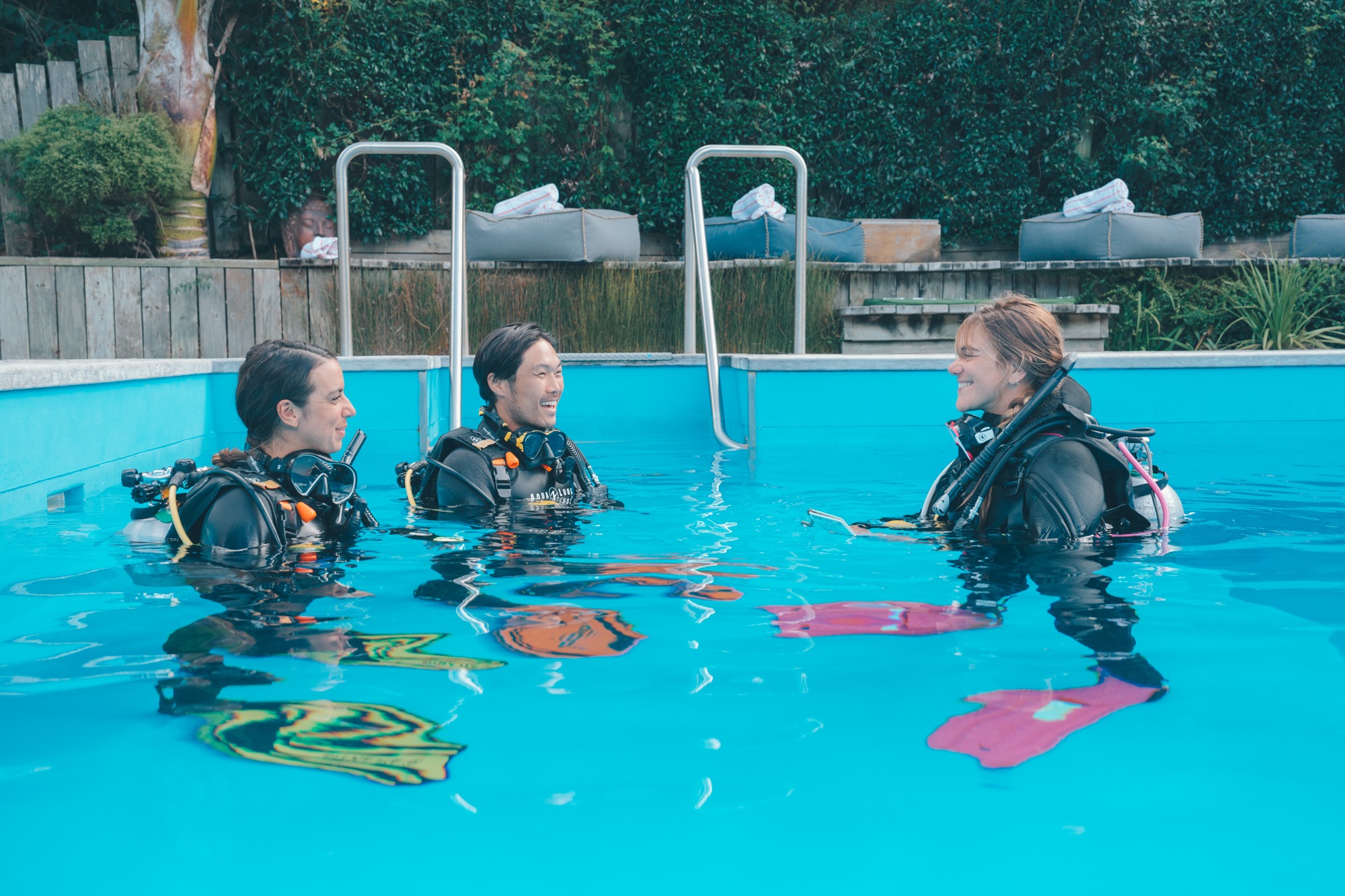
Small Groups, Top Gear & Personal Instruction: The Dominik Weckherlin Difference
Most dive training organisations measure success in volume. More candidates, more certifications, more revenue. I’ve chosen a different model — one built around three non-negotiable commitments: small groups, quality equipment, and deeply personal instruction. This article explains what each of those commitments actually means in practice, and why I believe they’re inseparable from genuine quality.
- 👥 Max 8 Candidates — Every candidate gets individual attention, every single day of the IDC.
- 🛠️ Top-Spec Equipment — Tools that perform reliably so candidates focus on learning, not compensating for gear.
- 🤝 Personal Instruction — Coaching adapted to each individual’s strengths, gaps and learning style.
Why Small Groups Matter — More Than You Might Think
The PADI standards allow for IDC groups of up to a certain size. I cap mine at 8 candidates. The difference isn’t just about comfort — it’s about the depth and quality of instruction that’s actually possible.
In a group of 8, I can watch every candidate perform every skill. I can give precise, individualised feedback after each confined water session. I can notice when one person is compensating for poor trim with their arms, or when another is rushing through a skill demonstration due to nerves rather than technique. In a larger group, those nuances disappear into the noise.
Teaching is also a deeply interpersonal activity. Within two days of a small IDC cohort, I know how each candidate learns — who needs encouragement, who needs challenge, who processes feedback better in writing versus verbally, who has a tendency to overthink. That knowledge makes every subsequent interaction more effective. In a group of 20, it’s impossible. In a group of 8, it’s unavoidable.
“I cap at 8 not because PADI requires it, but because anything larger compromises what I’m there to deliver. Quality isn’t scalable beyond a certain point — and I’d rather do this properly.”
— Dominik Weckherlin
Equipment: Why It’s Not a Trivial Detail
Dive equipment affects learning in ways that are easy to underestimate. Regulators that breathe hard distract candidates from focusing on buoyancy during skill demonstrations. BCDs with worn bladders that don’t hold air consistently make trim exercises frustrating rather than instructive. Masks that leak slightly divide a candidate’s attention between the skill they’re practising and managing water in their face.
Well-maintained, modern equipment removes these distractions entirely. When gear performs reliably, candidates can direct 100% of their cognitive attention to what they’re actually supposed to be learning. That sounds like a small thing. In a course as intensive as an IDC, it compounds significantly over two weeks.
Both TSK Zürich and SeaExplorers Philippines maintain equipment to a high standard. That’s a non-negotiable condition for me operating from either facility.
What Personal Instruction Actually Looks Like
Personal instruction isn’t just about being friendly or remembering names. It means building a coaching relationship with each candidate that evolves throughout the IDC. By week two, I’m not giving the same generic feedback to everyone — I’m addressing the specific, individual patterns that have emerged in each person’s teaching and diving.
For one candidate, that might mean working on pacing in classroom presentations. For another, it might be developing the confidence to correct a student’s skill error calmly and precisely underwater. For a third, it might be purely about managing pre-IE nerves through structured practice.
That granularity of attention is only possible because the group is small enough to allow it, and because I invest the time outside of formal sessions to think about each candidate individually. It’s more work. It produces better instructors.
The Standard You Carry Into Your Career
The standards you’re held to during your IDC become the baseline you apply in your own teaching. Candidates who are trained in environments where quality is genuinely prioritised — where equipment is good, groups are small, and feedback is precise — develop an intuitive sense of what good looks like. They carry that standard into every course they teach.
That’s the multiplier effect of quality IDC training. It doesn’t just produce one good instructor — it produces someone who will pass those standards on to every diver they certify for the rest of their career.