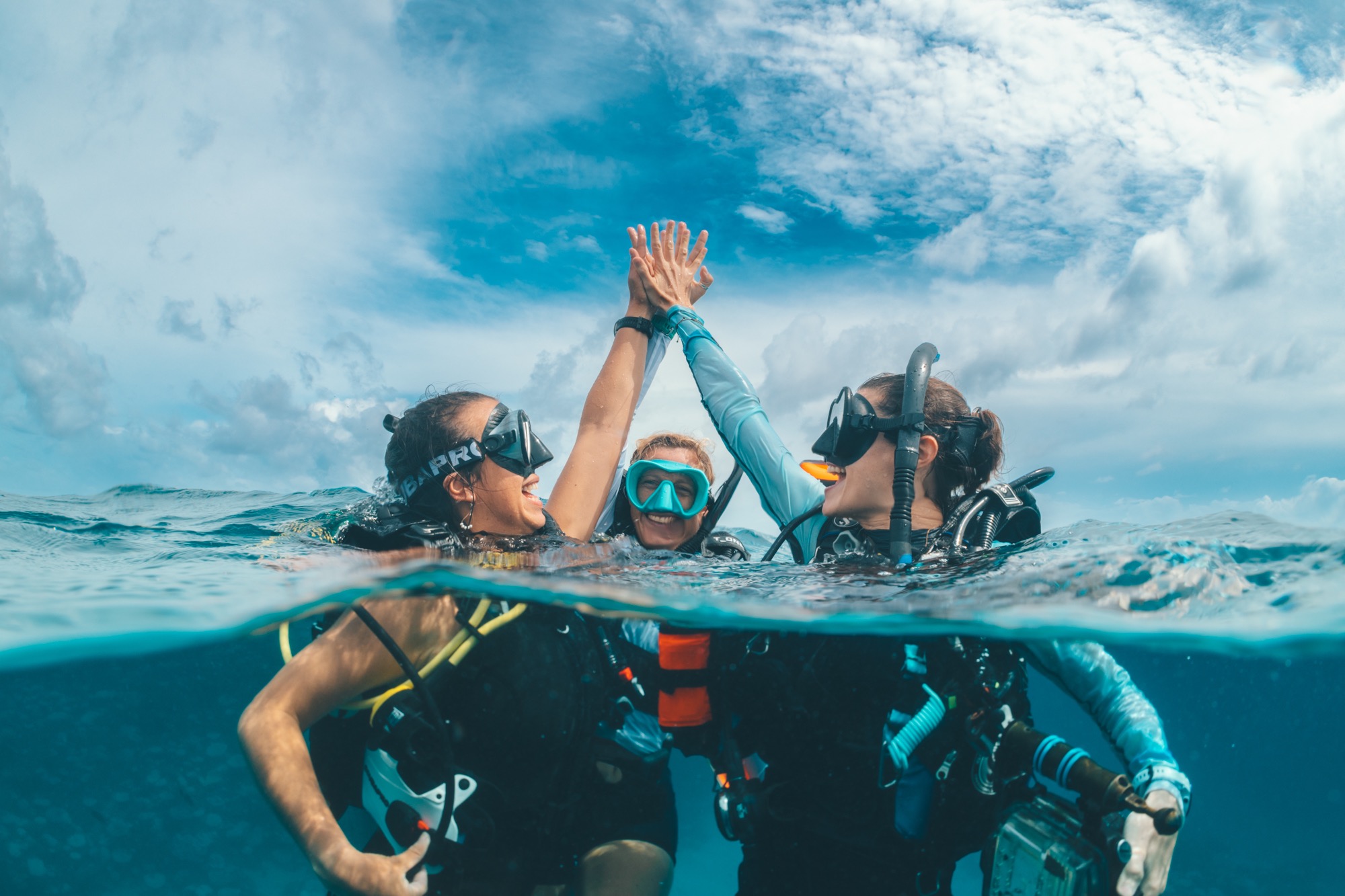
What to Expect During Your IDC: A Day-by-Day Breakdown
One of the most common things I hear from candidates in the lead-up to their IDC is: “I don’t really know what I’m getting into.” That uncertainty is completely normal. The IDC is unlike any dive course you’ve done before — it’s longer, more demanding, and fundamentally different in focus. You’re not learning to dive better. You’re learning how to teach someone else to dive safely.
This article walks you through what a typical IDC looks like, phase by phase. Not every IDC is identical — location, group dynamics and the Course Director all shape the experience — but this gives you a solid framework for what to expect.
Before You Arrive: The eLearning Phase
The IDC begins before you step on site. PADI’s eLearning system contains a significant portion of the academic knowledge required for the Instructor Examination. You’ll study dive physics, physiology, decompression theory, PADI’s teaching philosophy, and the Standards & Procedures that govern everything an instructor does. This material is detailed and takes time — plan for 20–30 hours of focused study before your first day on site.
Don’t underestimate this phase. Candidates who arrive having thoroughly completed the eLearning are noticeably more confident in the academic sessions. Those who skip it end up spending precious course time catching up rather than refining.
Phase 1 — Orientation & Assessment (Days 1–2)
Day 1 — Introductions, expectations & baseline assessments
We meet as a group, establish expectations, and run through the course structure. You’ll complete a written knowledge assessment so I understand where each candidate stands academically. We also review your dive skills with a watermanship test — basic but important: you need to demonstrate that you are comfortable and controlled in the water.
Day 2 — PADI System overview & teaching philosophy deep dive
The first full academic day. We work through PADI’s teaching philosophy, the structure of the System of diver education, and how the different courses relate to one another. You’ll begin thinking about diving from a teaching perspective for the first time — which is a genuine mental shift for most candidates.
Phase 2 — Academic Development (Days 3–6)
This phase is intensive. You’ll be presenting classroom knowledge development sessions to your fellow candidates, who role-play as students. You’ll be critiqued — by me, and by each other. The goal is to develop your ability to explain complex concepts clearly, manage a classroom, handle questions, and maintain student engagement.
Topics covered include dive physics and physiology in depth, equipment knowledge, dive planning, and the full spectrum of PADI courses you’ll be qualified to teach. You’ll also work through the rescue and emergency procedures that form a non-negotiable part of every instructor’s skill set.
“The first time you stand up and teach your peers, it feels awkward. By day six, it feels natural. That transformation is the whole point.”
— Dominik Weckherlin
Phase 3 — Confined Water Development (Days 5–8)
Confined water sessions run in parallel with the academic phase. Here you’ll refine and demonstrate the full list of PADI Open Water Scuba Instructor skills — not just performing them yourself, but demonstrating them to teaching standard: controlled, slow, clearly visible, and repeatable. You’ll also learn how to identify and correct student errors, which requires a new level of attentiveness underwater.
These sessions are where many candidates discover skills they’ve been doing habitually but imprecisely for years. The IDC reveals them — which is exactly the point. Better to refine now, under supervision, than to cement bad habits into your teaching.
Phase 4 — Open Water Development (Days 7–10)
Open water development moves the classroom to the real dive environment. You’ll plan and lead dives as an instructor, conduct student briefings and debriefs, manage simulated student problems underwater, and demonstrate the full suite of open water skills in conditions that aren’t always cooperative.
This is the phase where it all starts to come together. The planning, the teaching, the safety awareness, the communication — you’re orchestrating all of it simultaneously. It’s challenging. It’s also exhilarating.
Phase 5 — IE Preparation & Mock Exams (Days 9–12)
The final phase of the IDC is focused entirely on preparing you for the PADI Instructor Examination, which is conducted by an independent PADI Examiner — not your Course Director. The IE assesses everything: academics, confined water skills, open water skills, and rescue scenarios.
In this phase we run full mock IE scenarios, timed knowledge assessments, and individual feedback sessions. I identify any remaining gaps and we address them directly. My goal is for every candidate to walk into the IE feeling genuinely prepared — not just hoping for the best.
What Makes It Hard — and What Makes It Worth It
The IDC is mentally demanding in a way that surprises many candidates. It’s not physically exhausting like a DM internship — it’s cognitively intense. You’re processing new frameworks, practising skills to a new standard, accepting critique gracefully, and performing under observation every single day. That requires resilience.
What makes it worth it is the transformation you undergo. Candidates who arrive as competent recreational divers leave as educators — people who understand their sport at a depth that changes how they experience it forever. Every dive you take after your IDC will be different. You’ll see the water differently, understand conditions more acutely, and carry a quiet confidence that only comes from real preparation.
If you have questions about the IDC structure or want to understand how my specific programmes in Zürich and Dauin compare, download the Info Pack or reach out directly. I’m always happy to talk it through.